Why Serbia's Students Fought for European Values Without Waving European flags
For years, the EU treated Aleksandar Vučić as a partner in keeping the Western Balkans stable, even as concerns over democracy in Serbia grew. Now, after a student movement brought his government down, Brussels faces an uncomfortable question: did its pursuit of stability come at the expense of the democratic values it claims to defend?
On 1 November 2024, a Serbian high school student was getting ready to sing with their school choir. It was the day of his school’s annual celebration, and he faced an ordinary dilemma: take the train to the performance or squeeze onto a crowded bus. He chose the bus.
After the performance, he switched on their phone and found 25 missed calls. His mother had been trying to reach him, and when he finally got through to his best friend, she was crying. “I thought you were there,” she said.
A concrete canopy above the entrance to Novi Sad railway station had collapsed. Sixteen people lost their lives. He rushed home to collect documents, went to donate blood and later made his way to the station, where rescue workers were still searching through the wreckage.
Almost a year later, he described the country's frustration in a sentence that would become difficult to forget: “12 months, 16 victims, 0 accountability.”
What followed was not simply a protest against a construction disaster. It became a nationwide challenge to a political system that many Serbians believed had allowed corruption and political connections to become more important than public safety.
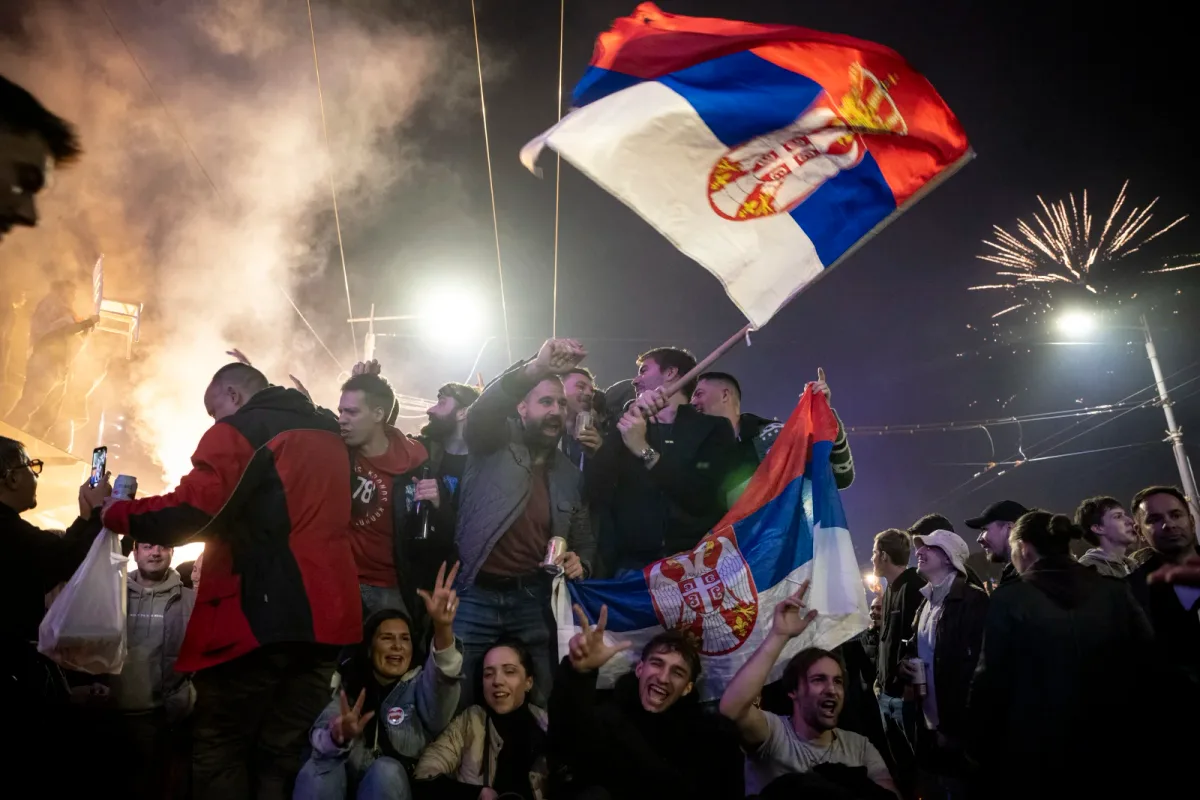
When hundreds of thousands took to the streets, one detail was striking: there were no EU flags among the crowds, as you would often see in other Eastern European mass protests.
That absence says a lot about the complicated relationship between Serbia, its student movement and the European Union. So why did a movement demanding the democratic values Brussels claims to defend have so little interest in waving its flag? And why are European leaders now celebrating a political change they did so little to encourage? Let's dive in.
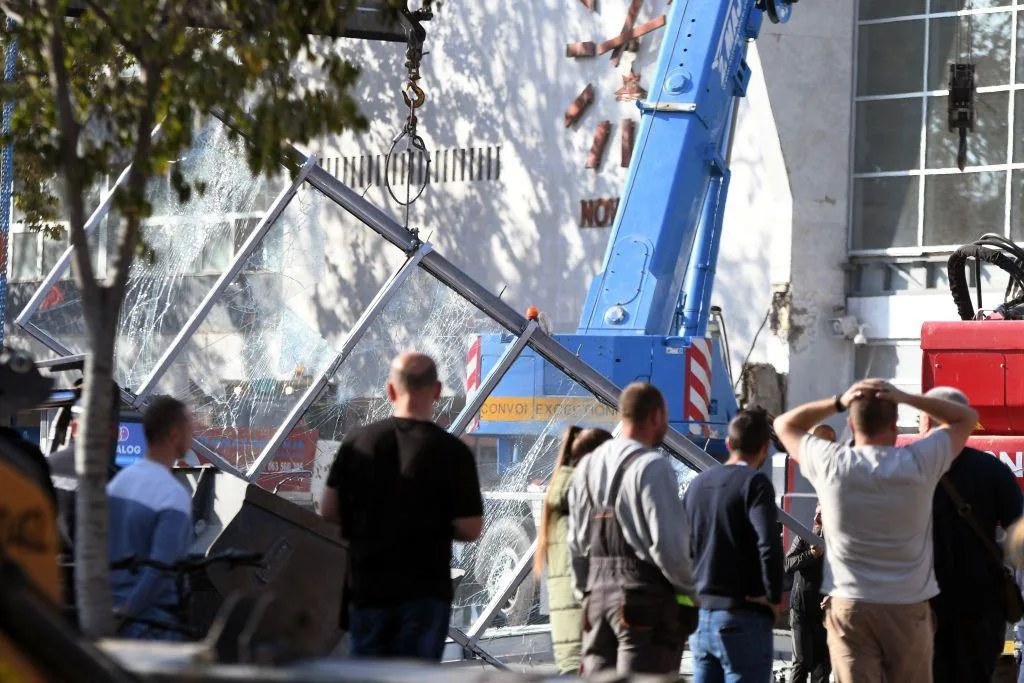
The questions after the Novi Sad collapse seemed straightforward: who approved the station's reconstruction, where were the contracts, and why had nobody been held responsible?
Students began occupying their university faculties and organised their movement around four demands: publish the reconstruction documents, prosecute those responsible, drop charges against detained protesters, and increase higher education funding by 20%.
What made these demands so powerful was precisely how difficult they were to argue against.
Students were not initially asking for a new foreign policy or a place in the European Union; instead, they demanded transparency, justice, and a government that could be held accountable when its decisions cost people their lives.
As time passed, the lack of response from the government made students increasingly frustrated, and eventually the movement grew beyond university campuses, bringing together teachers, farmers, lawyers, workers and families who had grown tired of the government of Aleksandar Vučić, whose Serbian Progressive Party (SNS) had been in power since 2012.
On 15 March 2025, Belgrade became the centre of that frustration.
I was there that day. The independent Archive of Public Gatherings estimated that between 275,000 and 325,000 people attended, while the Serbian Interior Ministry put the number at around 107,000.
Some observers and participants suggested that the real number could have been much higher, even approaching a million, although those larger estimates cannot be independently confirmed.
What I can say is that the official and independent figures did not capture the full experience of trying to reach the capital: I know people who never made it into Belgrade because they were stuck in completely stationary traffic around 20 kilometres outside the city.
It was difficult to look at the crowds and think of this as an ordinary political demonstration. People had travelled from across the country, many students had walked for days to reach Belgrade, and the atmosphere was shaped as much by grief and solidarity as by anger.
The protest was called “15 for 15”, a tribute to the victims, and during the 15-minute silence the scale of the gathering became particularly striking.
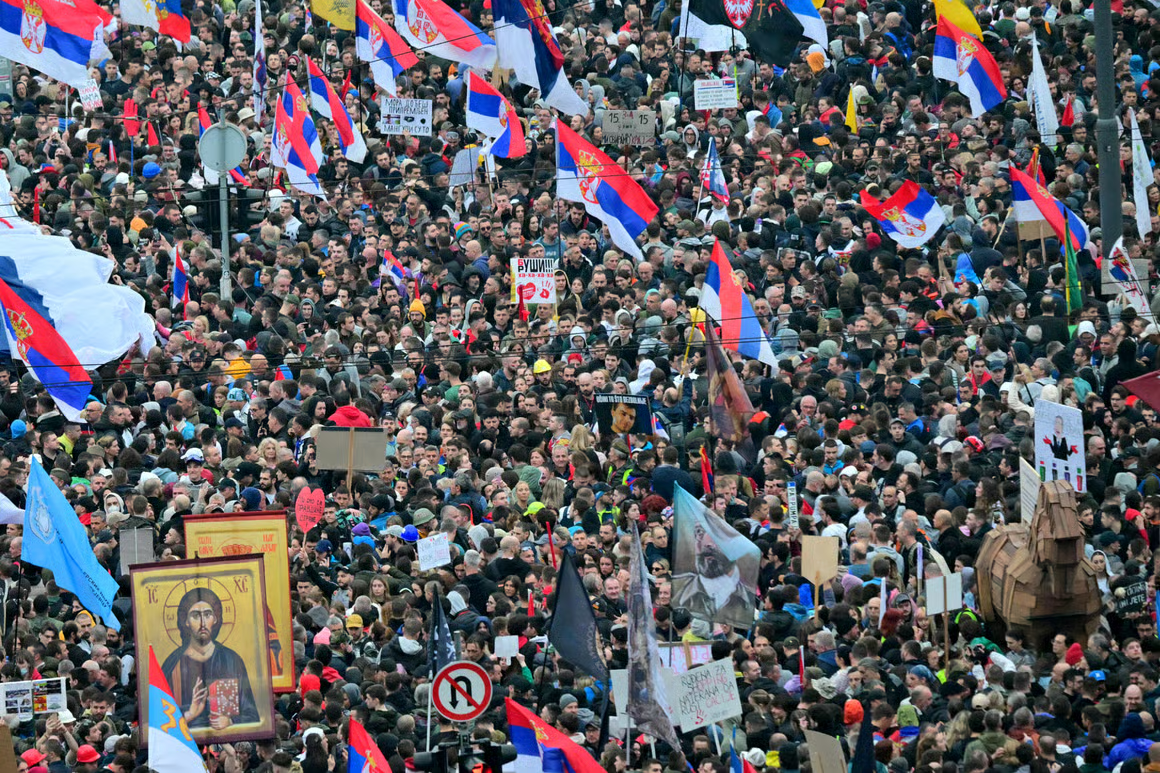
Yet, despite the size of the crowd and the movement's increasingly political consequences, the protesters were not carrying European flags or calling for Brussels to lead the way. Most visible political symbolism was deliberately avoided, with Serbian flags and the movement's own messages taking centre stage.
The absence of EU flags was not simply an aesthetic choice.
But there was another reason for the distance: many protesters felt that the EU had spent years accommodating Vučić while his government weakened the very democratic institutions that Brussels claimed to defend.
A Serbian student involved in the demonstrations explained this frustration in an interview published by Tufts University's Hemispheres magazine. When asked about the EU's condemnation of state repression, she said it was encouraging, but added that she had been dissatisfied with how long the EU had taken to speak up.
She also made clear that European support mattered because it could put pressure on Vučić and his government to respect their responsibilities towards Serbian citizens, but joining the EU was not the movement's end goal. Students were deliberately avoiding political symbols because they wanted their demands to bring together people who did not necessarily share the same views on Europe.
That distinction is important. The student was not rejecting Europe or democratic standards. She was questioning why European institutions had not used their influence earlier, when the government was already facing serious criticism.
And it is not difficult to understand where that frustration came from.
Serbia's democratic decline was hardly invisible to European officials. Freedom House describes the country as a hybrid regime, V-Dem classified it as an electoral autocracy in 2023, and Reporters Without Borders recorded a fall in Serbia's press freedom ranking from 54th in 2013 to 104th in 2026.
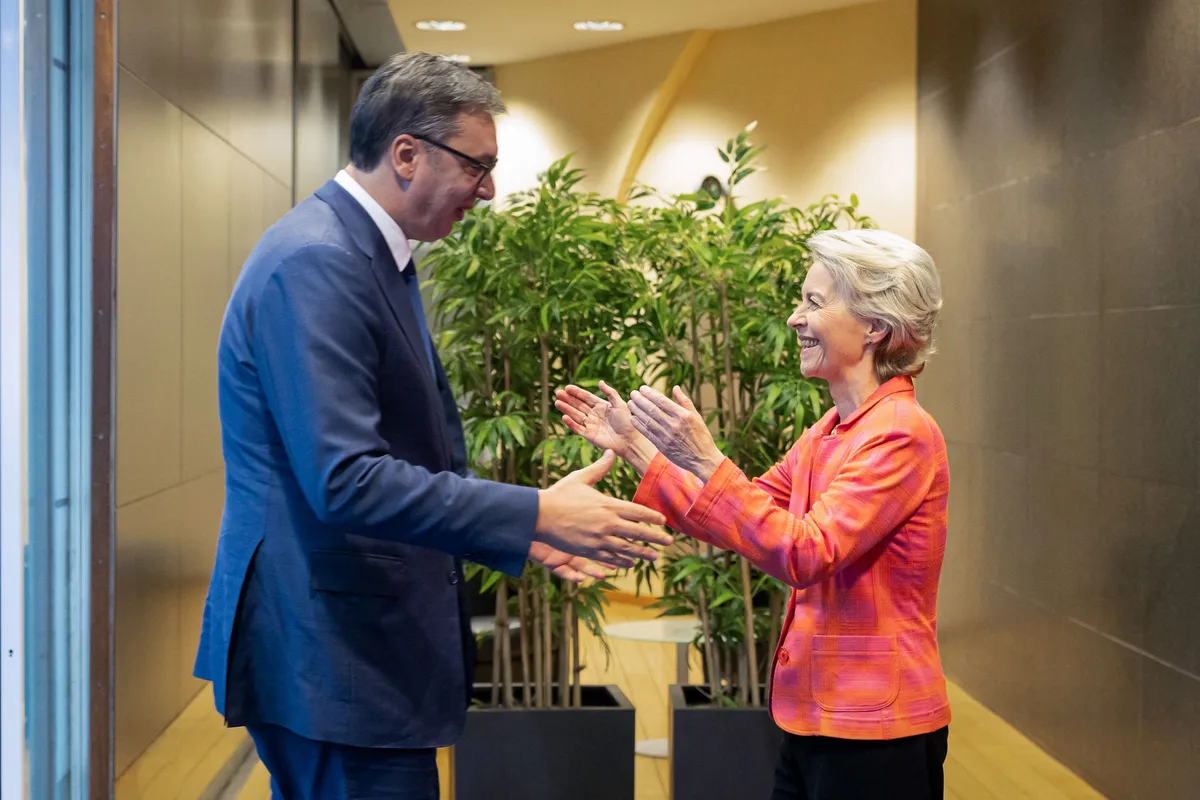
Nevertheless, in October 2024, just one week before the Novi Sad disaster, Commission President Ursula von der Leyen visited Belgrade and described Serbia as one of the most advanced countries in the EU accession process. The Commission had raised concerns about the rule of law and democratic standards, but high-level political cooperation with Vučić continued.
The relationship was not just diplomatic.
Consider the proposed lithium mine in Jadar, which had been shelved in 2022 after mass protests before the Serbian government revived it in July 2024. Just three days later, Serbia and the EU signed a strategic partnership on raw materials, despite widespread public opposition to the project.
Around 30,000 people protested in Belgrade that August, while the European Commission continued to defend its partnership with Serbia. In June 2025, Jadar was named a strategic project. Rio Tinto eventually put it on hold later that year.
France also had its own reasons to maintain close ties with Belgrade. In August 2024, Emmanuel Macron secured a €2.7 billion deal for 12 Rafale fighter jets, while French companies were involved in the management of Belgrade's airport and the supply of trains for its metro. Even in June 2026, Macron was still praising the positive momentum in relations with Vučić.
There was also a geopolitical calculation. Serbia refused to impose sanctions on Russia after the invasion of Ukraine, but the Financial Times estimated in 2024 that around €800 million worth of Serbian ammunition had reached Ukraine through third countries. This does not mean that the EU arranged those sales, but it does help explain why Western governments continued to see Vučić as a useful partner.
Analysts have described this approach as “calculated pragmatism”, prioritising regional stability and strategic interests, even when the democratic record of a partner government is deteriorating. For Brussels, Vučić was someone with whom it could negotiate. For many Serbian protesters, however, he was the very person from whom their country needed to be freed.
The EU's relationship with Vučić helps explain why the student movement's electoral success carries a message beyond Serbia's borders. In the election of 25 October 2026, the student-backed list won 52.71% of the vote and 140 of the 250 seats, according to preliminary results, while the SNS received 39.17%. European leaders quickly welcomed the result, with Enlargement Commissioner Marta Kos declaring that “the door to the EU is open”.
But Brussels should be careful about interpreting this as a victory for European integration.
The Student List's programme focuses overwhelmingly on domestic reform: public procurement, education, media freedom, independent courts and healthcare. Its position on foreign policy is more complicated, including opposition to sanctions on Russia and support for Kosovo remaining part of Serbia.
At the same time, the idea that young Serbians are simply anti-European does not match the available polling. More than 63% of Serbians aged 18 to 29 support EU membership, according to a survey by the EU Delegation, while 75% of Student List voters favour closer relations with the Union.
The contradiction is therefore not that young people reject Europe, but that many of them distinguish between the democratic values they associate with Europe and the European institutions they believe failed to stand up for those values in Serbia.
This is perhaps the most uncomfortable lesson for Brussels. The students were asking for transparency, accountability and independent institutions, principles that are supposed to be at the heart of the EU's enlargement policy. Yet only 27.7% of Serbians believe that the Union applies the same rules to every candidate country.
The European Union has reasons to want a stable Serbia, and it is not unreasonable for it to pursue cooperation on trade, security and regional relations. But when that cooperation appears to come at the expense of democratic accountability, it risks undermining the very influence it hopes to exercise.
The student movement did not begin with a promise to bring Serbia closer to Brussels, and its supporters did not fill the streets because they wanted European politicians to choose their next
government. They came because 16 people died, because they wanted answers, and because they believed their country deserved institutions that worked for its citizens rather than for those in power.
Europe can celebrate the election result, but it cannot claim ownership of the movement that made it possible.
If Brussels wants to become a genuine ally of Serbia's democratic future, it will have to show that its commitment to the rule of law matters just as much when Vučić is in power as when he is not.
SOURCES
021.rs (2026). Studentski plan za spoljnu politiku: Evo šta su im nacionalni interesi. In Serbian.
AFP (2025). Footage of anti-corruption protest in Belgrade misrepresented online. ● Associated Press (2025). Serbian farmers join striking university students’ 24-hour traffic blockade in Belgrade. Via VOA, 27 January.
Baccini, F. (2025). Serbia: the EU and the responsibility to support student protests. Osservatorio Balcani Caucaso Transeuropa, 30 January.
Balkan Green Energy News (2024). Serbia signs MoU with EU, backing Rio Tinto’s Jadar lithium project.
BBC News na srpskom (2025). Za Beograd: Studenti iz Subotice, Čačka i Niša krenuli na višednevno pešačenje. Via Danas, 10 March. In Serbian.
Electrive (2025). Rio Tinto puts Jadar lithium project in Serbia on hold.
EU Delegation to Serbia (2026). Public support for EU membership in Serbia shows cautious growth, with strong backing among youth.
Euronews (2024). EU remains fully committed to lithium deal despite unrest in Serbia. ●
Euronews (2026a). EU hails Serbia’s political upheaval after student group ends Vučić’s rule. ●
Euronews (2026b). Serbia’s student victory raises hopes of an EU reset.
European Commission (2024). Statement by President von der Leyen at the joint press conference with Serbian President Vučić.
European Policy Centre, Belgrade (2026). CEP Survey Report 2026.
European Policy Centre, Brussels (2026). Serbia’s students won the election, now comes the EU’s test.
European Western Balkans (2024). Key findings of the 2024 European Commission Report on Serbia.
European Western Balkans (2025). European Commission approves controversial Serbian lithium project as strategic for the EU.
European Western Balkans (2026). Most EU supporters oppose the SNS government. ● Freedom House (2026). Serbia: country profile.
Garrett, S. (2026). Interview with a Serbian Protester. Hemispheres, Tufts University, 14 April.
Gjoni, I. (2025). Why the EU must change course on Serbia. Carnegie Europe. ● Government of Serbia (2022). Government revokes spatial plan for Jadar. 20 January. ● The Guardian (2025). Protesters march in Belgrade at huge rally against Serbian president. 15 March.
Ivković, A. (2025). History of undeserved praise for Vučić. European Western Balkans, 14 October.
JAMnews (2026). Serbia protests timeline: how students brought Vučić’s 12-year rule to end. ● Kekić, T. (2025). Serbian workers, lawyers and professors join growing student protests. bne IntelliNews, 21 January.
Le Monde (2025). Belgrade’s historic day of anger: Hundreds of thousands of Serbians protest for laws and justice that work. 16 March.
N1 (2023). From democracy to autocracy: Serbia has been sliding all lists since 2014.
N1 (2024). FT: Serbia indirectly exported ammunition worth 800 million euros to Ukraine.
N1 (2026). Macron’s praise for Vučić driven by business interests, journalist says.
OSW Centre for Eastern Studies (2024). Macron in Serbia: business above all.
Radio Free Europe/Radio Liberty (2025). Serbia’s Vucic says government gets ‘the message’ after biggest protest in decades. 16 March.
Reporters Without Borders (2026). Serbia.
Sarajevo Times (2024). Eight dead in a collapse of the Novi Sad railway station. 1 November.
Seliverstova, A. (2026). Absent Europe: Civic Protest and the Erosion of EU Symbolism in Serbia. JCMS: Journal of Common Market Studies.
UN Special Rapporteur on Human Rights Defenders (2025). Guest blog: Testimony from a young Serbian human rights defender. 29 October.
YUCOM (2025). Monitoring report: Okupljanje studenata u blokadi “15. za 15”. 2 April. In Serbian.