My Grandfather Escaped Hungary in 1956. The Country is Still Arguing Over What That Year Means.
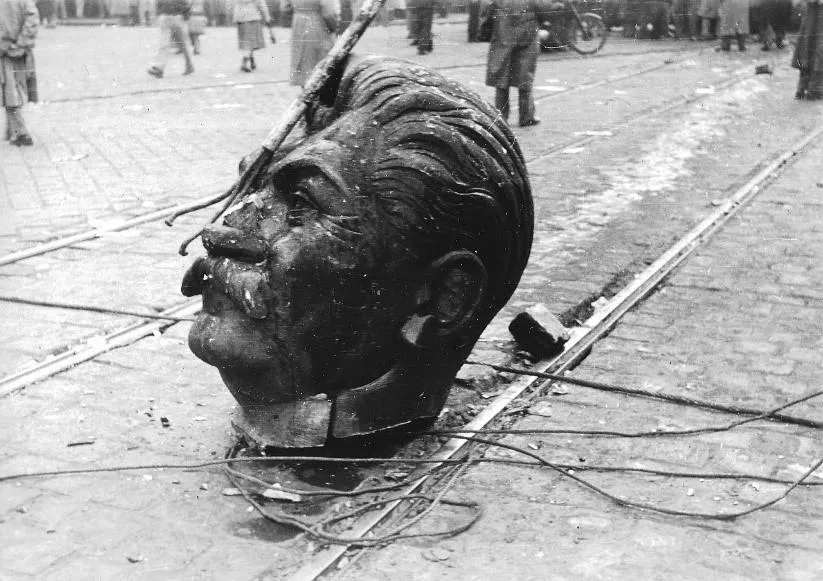
When I was twelve, my grandpa Papajoe was invited to my school to speak about his experiences during the Hungarian Revolution of 1956. I had always listened to his stories in awe, and I couldn’t wait for my buddies to hear them. As he slowly started to speak, I waited for one story in particular.
The bridge.
After making the difficult decision to leave Hungary, Papajoe set out with a friend, his sister, and her fiancé. When they reached the bridge into Austria, they stopped dead in their tracks. A young soldier stood guard with a gun aimed at him and his company.
Papajoe was twenty-one. He began walking across the bridge, eyes locked with the soldier’s. As he later told it, the soldier seemed unsure what to do, it would have been his duty to shoot them on the spot. He kept moving. Slowly, they walked past.
The soldier let them go.
I knew how the story ended. The man who had survived got to hold his baby grandson in his arms. Yet knowing the ending never made that moment less frightening: a family trying to leave, an armed young man watching, and a future that could have been taken away in seconds.
The revolution began on 23 October 1956, when a student demonstration in Budapest grew into an uprising against communist rule and Soviet domination. The students stood and protested for the withdrawal of the Soviet troops, competitive elections, and the Hungarian people’s freedom of expression. Their vision joined national independence to the rights of ordinary people of the country.
For a small period, change seemed impossible. Imre Nagy’s government moved towards a multiparty system and declared Hungary’s neutrality. Soon after, on the 4th of November, the Soviets launched the assault that crushed the revolution and secured a new leadership under János Kádár.
Approximately 200,000 Hungarians fled. Papajoe and his company were part of that exodus. Behind the vast number, there were individual decisions to abandon familiar lives for uncertain futures. For my grandfather, the uncertainty of a young soldier on a bridge became one of many.
For those who remained, the defeat shaped the country’s political life for decades. Kádár’s government secured its position by portraying the uprising as counterrevolutionary, while public discussion of what happened was under strong effort to be kept silent. Remembering became political; a personal account could contradict the story the state told about itself.
In June 1989, Nagy’s public reburial became a huge and defining moment in Hungary’s political transition. Among the speakers was a young Viktor Orbán. The revolution’s memory helped pave the way for a new democratic order.
Decades later, Orbán leveraged that same history from a position of power. In his 2023 anniversary speech, Orbán drew a strong comparison between previous Soviet rule and pressure from the European Union. Emphasising how his disputes with Brussels was a fight for Hungarian independence, using the same language that was used towards Moscow in 56.
Such comparisons deserve scrutiny. The distinction between the two cases is really important: disagreement within a union Hungary voluntarily joined is different from military occupation. Furthermore, the students of 1956 weren’t just demanding that the Soviets leave; they wanted rights and freedoms that Hungarian leaders would have to respect.
Standing up to foreign powers doesn’t automatically mean a leader is defending freedom.
Hungary’s change of government opened a new chapter for the country. Péter Magyar became prime minister in May 2026, ending Orbán’s sixteen consecutive years in office. In a speech to parliament marking the anniversary of Nagy's reburial, Magyar himself warned against making day-to-day political capital out of the revolutionaries' story. He did that while also framing his own government as the fulfilment of 1956.
No election can transfer the ownership of that history. Any government claiming its position in Hungary should be judged by how it treats the freedoms the revolutionaries sought.
For myself, my family’s story brings that responsibility closer to home. I cannot know what the soldier believed or why he let them pass. I know only what Papajoe described, and what depended on that moment.
At twelve, I wanted my friends to hear my grandfather’s adventures. As I have grown, “adventure” feels incomplete. It captures the excitement of listening while leaving out the uncertainty of living through a story before it even has an ending.
The revolution of the past lies in speeches and arguments about Hungary’s future. It also survives in families who can tell their stories because someone lived long enough to pass them on.
On that bridge, Papajoe walked past a soldier. Years later, he stood in my classroom, and we listened.
It was life or death, and it was life.