While the World Pushes Immigrants Away, Spain Invites Half a Million

In January, Spain’s governing coalition announced they had passed a motion to regularize over 500,000 undocumented migrants.
The rules are simple: if you have spent 5 uninterrupted months in Spain before 2026, you do not hold a criminal record, and you do not currently hold any administrative status, you are allowed to obtain a legal residency and work authorization permit.
However, the response to this policy has not been so simple. A wide variety of political actors, ranging from Spain’s conservative opposition to the White House, have expressed complete outrage. People like Elon Musk have even called it an act of “high treason” towards the Spanish people.
Why has a domestic law of a middle power like Spain flooded news outlets across the entire globe? What are the economic and social implications of this mass regularization? Does Sánchez benefit politically from swimming against the right-wing populist tide currently sweeping international politics? Let's dive in.
The justification for this policy was twofold: a social dimension concerning the basic rights of undocumented persons, and an economic one respecting the labor shortage Spain is currently experiencing.
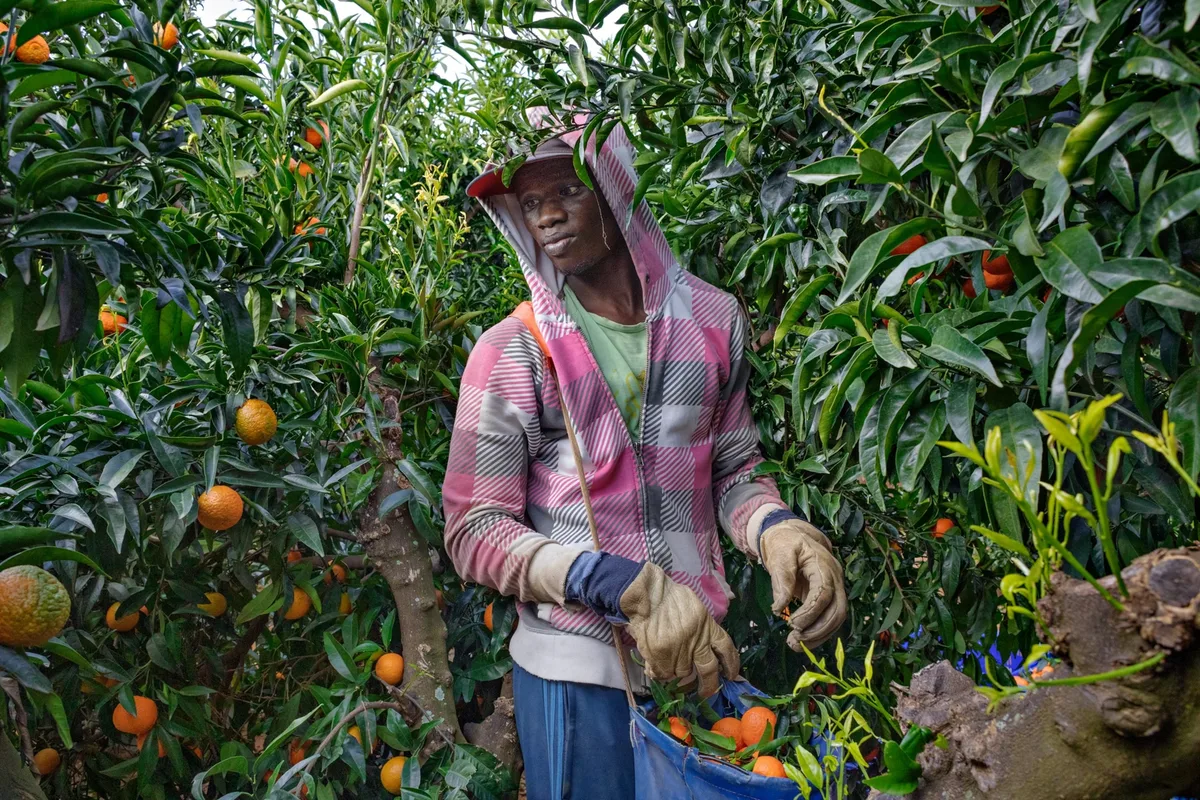
Socially, undocumented migrants in Spain have long dealt with intense labor exploitation. Those who are able to safely complete the journey from their home countries and find a job often encounter deplorable working conditions: long hours, scorching heat, no health insurance, and pay far below minimum wage.
Labor rights that are supposed to defend people against this kind of exploitation fail to apply to undocumented individuals, simply because the law doesn’t protect those who are not registered under it.
Mass regularization is intended to provide legal visibility to previously invisible people, affording them the rights and conditions every worker in Spain usually enjoys.
Studies have already shown that heat-related hospitalizations for workers have declined in provinces with greater exposure to the mass regularization policy, showing that it does indeed make people safer.
Economically, Spain’s low birth rates and ageing population (with an exceptionally high life expectancy) are putting the country at what experts call “a demographic crossroads”. Simply put, there are not enough active workers in the labor market to sustain the country’s historically generous welfare state (pensions, healthcare, public services).
Elma Saiz, Sánchez’s migration minister, has stated that Spain must register 250,000 foreign workers per year in order to sustain the welfare state at its current rate; hence this mass regularization program, which intends to provide documents to 300,000 migrants per year, for the next three years.
Regularization also means paying taxes and contributing to social security, continuing the net positive contribution of immigrants in Spain’s economy and ultimately mitigating its demographic challenge.
Much of Spain’s unemployment is structural: unemployed Spanish workers are not able or willing to work where labor is most needed. Many labor shortages concentrate in sectors like agriculture, elder-care, domestic work, and construction, which tend to be physically demanding, seasonal, and poorly paid.
Migrants make up for this shortage, as evidenced by 71% of domestic service workers, 45% of hospitality workers, 32% of construction workers, and 31% of agricultural workers being foreign.

The response from Sánchez’s opposition, as well as the broader global conservative movement, has been one of intense indignation.
Critics suggest that programs like these create pull factors to encourage more immigration, with fears of deteriorating Spanish cultural identity and social fabric. “We cannot take in even one more; we are not prepared, and some of us also simply do not want to. There are entire neighborhoods that remind you that you are in the Maghreb or in Quito.”, claims the Vox representative in the Catalan parliament.
Opponents of this policy also claim it violates Spanish rule of law, not only because of what it encourages, but also because of how it was passed.
Critics argue this program encourages and rewards illegality, as granting undocumented migrants a legal status motivates more potential migrants to come into Spain illegally, and undermines the credibility of the existing regular migration pathways.
Moreover, this policy was passed through a royal decree, a legal instrument in Spain that allows policies to take effect immediately in cases of “extraordinary and urgent necessity”. Sánchez argued this policy addressed an urgent humanitarian and economic necessity, as hundreds of thousands of workers were currently employed without full legal protection.
Opposition members argued that this regularization should have undergone the usual debate, scrutiny, and negotiations, describing it as a flagrant violation of the rule of law and Spanish democracy.
Overall, the mass regularization program has become one of Sánchez’s most controversial political moves in his 8 years of leadership.
While advocates champion the safeguarding of human rights and Spanish economic welfare, opponents believe this policy threatens to saturate public services, replace Spanish identity, and undermine the rule of law.
Long queues are already forming in front of administration buildings in Spain, and time will only tell the true effect this mass regularization will have on Spanish society.

Sánchez implemented this program just months before bidding for reelection, a political Hail Mary as some called it. Instead of mimicking the rhetoric of right-wing populism and assimilating their policies, as many incumbent leaders in Europe who face electoral defeat from their right-wing opposition have done, Sánchez went full force in the opposite direction.
This policy not only presents a clear clash against the Trump-era deportation politics, but also against the wider right-wing nationalist ideology sweeping over Western democracies.
Sánchez’s firm opposition to Trump and right-wing populism, not only on the issue of immigration but also on that of renewable energy, international law, and defence spending, has given his party what some call a political lifeline, turning him into the face of progressive politics worldwide. Recent polls estimate that Sánchez’s party will receive its highest voter share since the July 2023 elections, at 36.4%, 4.6 points higher than this last March.
Whether this strategy will translate into lasting political strength remains uncertain, but for now, Sánchez has turned his pro-migration stance into a defining symbol of his broader ideological campaign against global right-wing populism, and according to the polls, it seems to be working.
SOURCES
Amodio, Francesco, Elia Benveniste, Mario F. Carillo, and Marc Riudavets-Barcons. 2025. “The Effect of Migrant Regularization on Labor Exploitation.” Working paper, October 21. https://eliabenv.github.io/elia-benveniste-website/abcr_migrants.pdf.
Balcells Group. 2026. “Mass Regularization of Foreigners in Spain: Complete Guide for Undocumented Immigrants.” Balcells Group International Lawyers. https://balcellsgroup.com/mass-regularization/.
Demócrata. 2026. “Vox Acusa a Sánchez de Traicionar a los Españoles por la Regularización de Migrantes.” Demócrata, April 14. https://www.democrata.es/catalunya/vox-acusa-a-sanchez-de-traicionar-a-los-espanoles-por-la-regularizacion-de-migrantes/.
González Enríquez, Carmen, and José Pablo Martínez. 2026. “Immigration and the Labour Market in Spain.” Elcano Royal Institute, March 17. https://www.realinstitutoelcano.org/en/analyses/immigration-and-the-labour-market-in-spain/.
Goodman, Sara Wallace, and Matthew Wright. 2015. “Does Mandatory Integration Matter? Effects of Civic Requirements on Immigrant Socio-Economic and Political Outcomes.” Journal of Ethnic and Migration Studies 41 (12): 1885–1908. https://doi.org/10.1080/1369183X.2015.1042434.
Haddaway, Neal. 2025. “Let’s Not Forget the Migrant Workers Who End Up Being Exploited in Spain.” The Guardian, February 26. https://www.theguardian.com/world/2025/feb/26/lets-not-forget-the-migrant-workers-who-end-up-being-exploited-in-spain.
Horowitz, Jason. 2026. “How a Fight With Trump Threw Spain’s Leader a Political Lifeline.” The New York Times, April 18. https://www.nytimes.com/2026/04/18/world/europe/pedro-sanchez-donald-trump-lifeline.html.
Nicolás, José. 2026. “El PSOE Aventaja en Casi 13 Puntos al PP, Según el Barómetro del CIS de Abril.” El País, April 20. https://elpais.com/espana/2026-04-20/el-psoe-aventaja-en-casi-13-puntos-al-pp-segun-el-barometro-del-cis-de-abril.html.
Onda Cero. 2026. “Elon Musk Carga Contra Pedro Sánchez por la Regularización de Inmigrantes: ‘Es Culpable de Alta Traición.’” Onda Cero, April 20. https://www.ondacero.es/noticias/sociedad/elon-musk-carga-pedro-sanchez-regularizacion-inmigrantes-culpable-alta-traicion_2026042069e554439e87c91dbffae92e.html.